Landscheidt Cycles Research

January 25, 2012

Grand Harmonic Climate Model

Filed under: Uncategorized — Geoff Sharp @ 12:32 am
Tags:

grand harmonic climate model

Solar system dynamics are interwoven into all aspects of life as we know it. Gravity being the ultimate blacksmith that shapes our destiny. The very driver of the Sun’s Dynamo and Earth’s climate are harmonic resonances between the larger bodies in our solar system, which also mesh with magnetic/electrical forces.

These harmonic drivers can be broken down to three levels.

1. The Ice Age Cycles (Milankovitch, 100,000 years)(J/S/U/N)

2. Solar Grand Minimum & Solar Modulation Cycle (Sharp, 172 years)(J/S/U/N)

3. PDO/ENSO Harmonic Cycle (Scafetta, 60 years)(J/S)

This article will deal with the brief concepts behind each of the 3 levels along with interaction of each level with our atmosphere and,  how each player is inextricably linked with all layers of the atmosphere that work together to form a complex organic total system.

Level 1 was first proposed by Milutin Milankovitch during the years of the first world war. Planetary gravity forces from the outer 4 planets over 100,000 years gradually change the shape of Earth’s orbit from circular,  to elliptical along with shorter term changes in the inclination angle and winter precession timing. When a particular combination of the orbital elements is reached, high latitudes of the northern hemisphere begin to experience year round snow. This triggers year on year ice growth because of albedo changes, that now reflect solar energy away from Earth. The Earth spends 90% of its time in frozen conditions, with the recent warm Holocene period (11,500 yrs) drawing to an end. Ice Age cycles once invoked, over ride the smaller influences of level 2 and 3.

During the warmer Holocene type periods level 2 & 3 harmonic cycles rule the day.

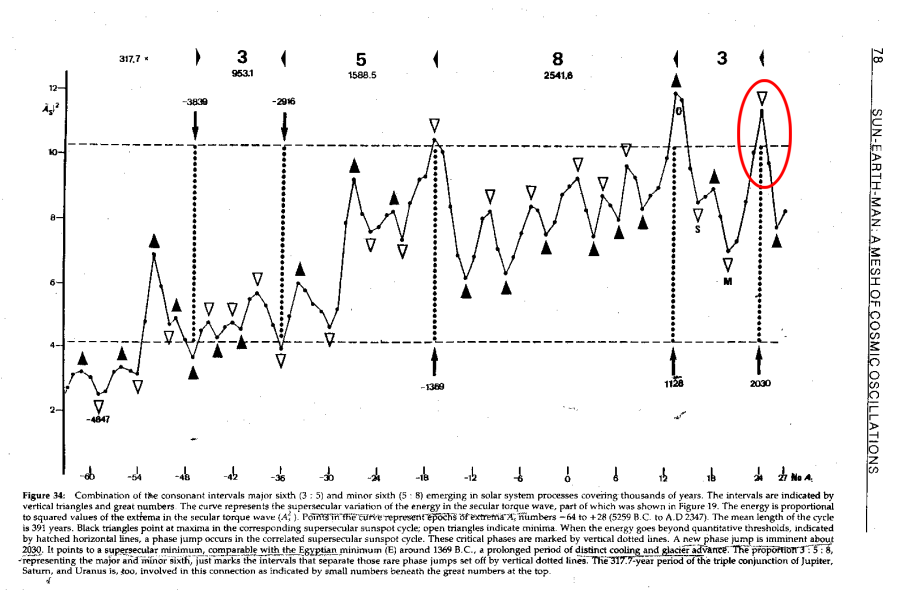
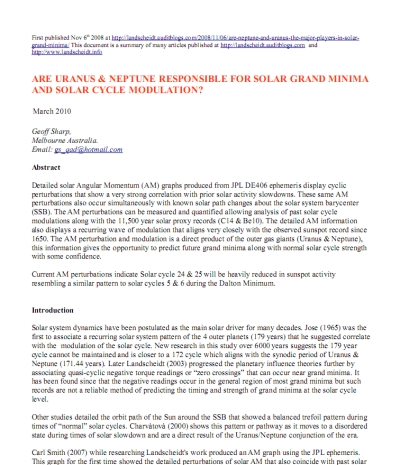
Level 2 was outlined in rough terms by pioneers such as Jose, Landscheidt and Charvàtovà who each identified crucial components, which where brought together and quantified with the assistance of Carl Smiths solar angular momentum graph. The new information led to discoveries which enabled quantification of the precise timing and strength of past and future solar grand minima, along with the discovery of the 172 year solar powerwave. This wave controls the overall solar cycle modulation. Many references can be found on this site on level 2 theory, along with a published paper found HERE. A recent paper by Wolff and Patrone (2010) has provided a physical mechanism for angular momentum theory. In summary level 2 forces shape the Holocene solar output and Earth temperature overall trends.

Level 3 is a well known 60 year cycle in Earth’s temperature record that in recent times aligns with the PDO/ENSO record. Nicola Scafetta has documented in several papers how the temperature record coincides with two solar system harmonic patterns. The solar velocity 60 year cycle and the Jupiter/Saturn synodic harmonic cycle along with Lunar harmonics being the thrust of his proposals. Level 3 influences can be strong, and potentially over ride level 2 when the 2nd level is not in a deep low stage. Level 2 is always present,  but having different influences depending on timing. The 60 year cycle in Earth’s temperature is most likely controlled by the PDO index which over the last 100 years aligns with global temperature. The PDO index is often portrayed by the warmist crowd as an “after effect of ENSO” in some attempt to diminish the crucial role the PDO plays in climate fluctuation, preferring us to believe CO2 is the main driver. In 2011 we saw clear evidence of the warm pool in the Pacific northwest (which is the main characteristic of the cool PDO phase) IS capable of “charging” the Walker Circulation pump that drives La Nina and inhibits El Nino. The neg PDO warm pool was responsible for the last stage of the back to back La Nina of 2010/11. The presence of the 30 year PDO warm pool will tend to favour La Nina over El Nino events which regulates Earth’s climate.

Further research is required to determine the cause of the PDO, but I am backing Dr. Scafetta at this point.

Effects on Earth’s Atmosphere.

Earth’s atmosphere may be broken up into multiple layers but each layer is part of a functioning overall system. The troposphere where we live (0-10km) is very much interlinked with all the layers above. Each layer receives different influences from the energy sources available, but interrelate as a whole, to form weather patterns experienced on the surface. When it comes to level 2 energies, the most variable are solar UV outputs, which have large potential to alter climate cycles.

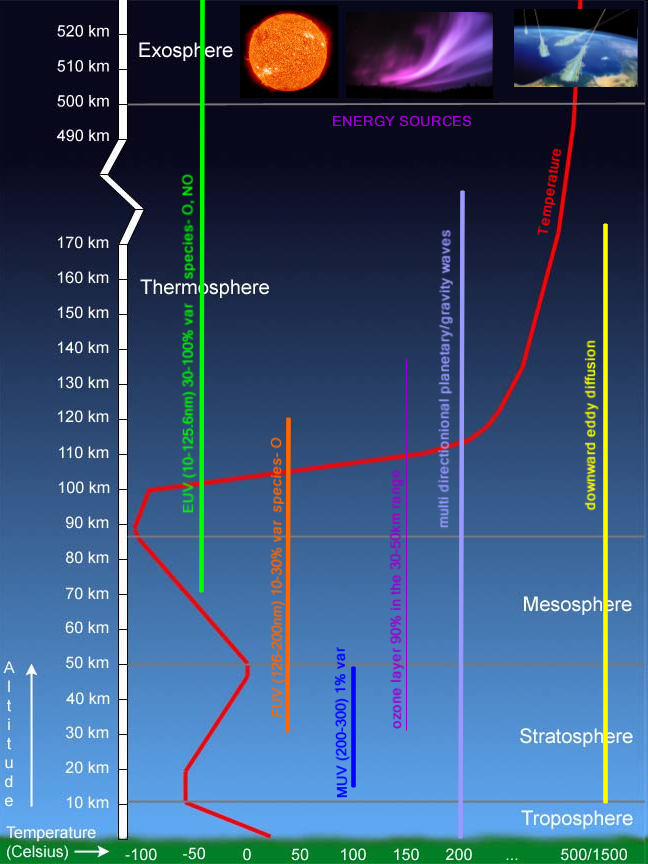
Solar UV ranges from 10-400nm on the spectral scale and is broken up into 3 basic categories. EUV is at the extreme end of the spectrum (10-125.6nm) which includes the important Lyman alpha portion which resides at the high end of the EUV scale. EUV values vary by 30-100% across the range over the solar cycle, and have the most potential to modulate atmospheric chemistry, size and temperature. FUV (126-200nm) also shows big variations in the 10-30% range and is a very important player along with EUV for ozone formation in the stratosphere and mesosphere. MUV (200-300nm) is a solid ozone backstop but only varies 1% over the solar cycle but still relevant when comparing overall TSI (total solar irradiance) variance of 0.1%.

Those that subscribe to the AGW religion will only push TSI when it comes to solar influence on climate. The records gathered from somewhat dubious satellites during the space age display a small 0.1% change in solar HEAT output over a few solar cycles. To really appreciate the true solar effect on climate it is necessary to include chemical changes and total solar influenced cloud cover to see the real picture.

Beginning with the most variable component of solar output spectrum, EUV has only in the last few decades been studied in detail, and is now one of the areas where real dollars are spent in space exploration.

EUV is mainly consumed above 100km in the thermosphere where the air density is low. Some of the climate relevant reactions occur in this region producing atomic oxygen and nitric oxide that later play a large role in ozone formation/control at lower levels. In the EUV range there is an important lively band in the Lyman alpha range (125.6nm) that penetrates down to 70km. As seen in the above diagram different ranges of the UV spectrum are absorbed at different altitudes, the Lyman alpha range is particularly strong and produces large amounts of atomic oxygen down to 70km that is used in the formation of ozone in the mesosphere. Soloman (1982) and others show how this atomic oxygen is also pumped down to lower levels to further assist ozone production, the downward mechanism coming from eddy diffusion. EUV can produce species that build ozone but it can also produce large quantities of nitric oxide (NO), that destroys ozone. Nearly all NO is produced in the thermosphere, with the majority portion coming from EUV interaction. But, during times of high aurora activity a process called EPP (Energetic Particle Precipitation) can produce as much as 50% of the total NO production. Solar proton events and cosmic rays also play their part which all come under the general umbrella of solar modulation. Several authors including (Soloman, 1982) and a good overall reference HERE  have shown that great quantities of NO are diffused down to the mesosphere and stratosphere where they have great influence in ozone formation (negative). The downward path coming from eddy diffusion and the downward flow to the northern polar vortex at the tale end of planetary and gravity waves. The ozone process is complex and little understood, but recent finds by Haigh are showing quantities of ozone can increase above 45km and decrease below during times of weak solar activity, which is no doubt brought about by the chemical changes that fluctuating EUV/FUV brings along.

Baldwin et al who are considered the experts in the QBO (stratospheric wind oscillation) speculate on the role of UV in the mesosphere and how modulation could play an important role in the break up of the northern polar vortex. The break down of the vortex is a key component of the AO index which is hard linked to the behavior of the jet stream.

“Because of the strong absorption of ozone in the UV occurring in the upper stratosphere and meso-
sphere, a solar influence on the thermal structure in these regions of the atmosphere is plausible. This, in
turn, might affect the strength of the planetary wave driven “extratropical pump” [Holton et al., 1995]. A
mechanism involving downward propagation of stratospheric anomalies, through modification of planetary
wave propagation from below, is discussed in section 6.2.”

The jet stream changes which drive cold air from the polar regions has provided colder conditions for the past 3 years, any changes to cloud cover extent which is also proposed by harmonic drivers will further increase the influence from exterior sources.

The links between solar activity and climate remain controversial, but headway is being made to oppose the IPCC rhetoric and dogma. Similarly the planetary links to solar and PDO drivers are also making headway as more research comes to hand. Nicola Scafetta has already proposed a Harmonic Climate Model which deals with the level 3 oscillations. Nicola is very aware of the higher levels that need to be fully incorporated, which perhaps may happen in print in the not too distant future.


November 10, 2011

Scafetta’s New Paper Linking Mid-Latitude Aurora to the 60 Year Temperature Cycle.

Filed under: Uncategorized — Geoff Sharp @ 12:48 pm

Nicola Scafetta has just sent me a copy of his latest paper “A shared frequency set between the historical mid-latitude aurora records and the global surface temperature

http://www.sciencedirect.com/science/article/pii/S1364682611002872

The abstract follows:

Herein we show that the historical records of mid-latitude auroras from 1700
to 1966 present oscillations with periods of about 9, 10–11, 20–21, 30 and
60 years. The same frequencies are found in proxy and instrumental global
surface temperature records since 1650 and 1850, respectively, and in
several planetary and solar records. We argue that the aurora records reveal
a physical link between climate change and astronomical oscillations. Likely
in addition to a Soli-Lunar tidal effect, there exists a planetary
modulation of the heliosphere, of the cosmic ray flux reaching the Earth
and/or of the electric properties of the ionosphere. The latter, in turn,
has the potentiality of modulating the global cloud cover that ultimately
drives the climate oscillations through albedo oscillations. In particular,
a quasi-60-year large cycle is quite evident since 1650 in all climate and
astronomical records herein studied, which also include a historical record
of meteorite fall in China from 619 to 1943. These findings support the
thesis that climate oscillations have an astronomical origin. We show that a
harmonic constituent model based on the major astronomical frequencies
revealed in the aurora records and deduced from the natural gravitational
oscillations of the solar system is able to forecast with a reasonable
accuracy the decadal and multidecadal temperature oscillations from 1950 to
2010 using the temperature data before 1950, and vice versa. The existence
of a natural 60-year cyclical modulation of the global surface temperature
induced by astronomical mechanisms, by alone, would imply that at least
60–70% of the warming observed since 1970 has been naturally induced.
Moreover, the climate may stay approximately stable during the next decades
because the 60-year cycle has entered in its cooling phase.

Dr. Scafetta has written several papers on the 60 year trend in global temperatures that align with a 60 year trend in the Solar velocity records. This same trend aligns with PDO record which is a warm and cool phase of the Pacific Ocean that also aligns with the frequency in the ENSO cycle (whether La Nina or El Nino’s dominate). This new paper demonstrates a 60 year period in the mid latitude auroras that suggests a solar output astronomical link in the 60 year cycle.

The theory suggests that during times of low solar output the reduced solar wind allows more cosmic rays to excite the outer atmosphere which then enhance any solar flare activity to a state whereby aurora can be visible at mid latitudes. The 266 year history for the most part does look to show a 60 year fluctuation with perhaps an irregularity around 1950-60. I am not totally convinced with this logic as mid latitude aurora can be a function of an over active Sun also which is in competition. (note: my initial reading of the paper was incorrect, see update below)

The possible causes of the PDO are of immense importance to understanding what drives the world climate and while I am not convinced with the aurora argument (see update) Dr. Scafetta does produce another interesting graph that corresponds very closely with the PDO record.

Graph A above displays the tidal effects on Earth from Jupiter & Saturn. A very clear 60 year period is observed which closely aligns with Graph B from his earlier papers that show the modulation of solar velocity. The two forces may be related but are quite distinct from one another. Solar velocity is modulated by the distance the Sun travels away from the SSB (solar system barycentre). The further the distance the faster the Sun travels around the SSB which is totally modulated by Uranus and Neptune. During my research I found the 60 year period came about from the positions of Uranus and Neptune during the Jupiter/Saturn conjunction/opposition. When Uranus/Neptune are together they provide boost (distance) to the Sun and also at other times when either Uranus or Neptune come together with the Jupiter/Saturn conjunction causing a triple conjunction. The last few hundred years shows this 60 year trend in solar velocity but I suspect that might change over longer periods.

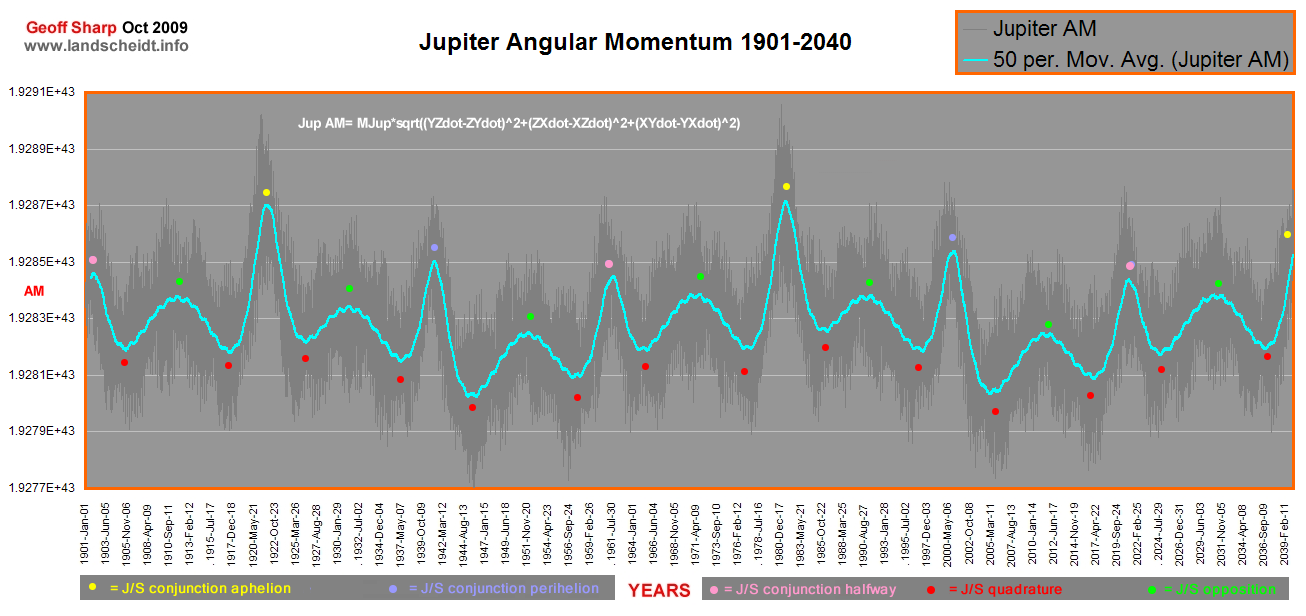
Graph A is completely different and shows tidal effects on earth that are not subject to planetary precessions and is far more accurate in my opinion of maintaining a more precise longer lasting 60 year period. The synodic period of Jupiter and Saturn does not vary with planet precession although their perihelion positions will vary over time producing a minor change. In April 2009 I produced a graph that nearly mirrors Nicola’s graph A but is based on the Jupiter perihelion/aphelion distances.

The modulation in Jupiter’s perihelion/aphelion distances is mainly brought about in my opinion by the gravitational perturbations induced by Saturn, a link to my original research can be found HERE. I am at odds with many in the scientific community that believe the gas giants do not orbit the Sun. Most I have had discussions with are of the opinion that the outer planets orbit the SSB, but my research strongly suggests at least Jupiter and Saturn have the Sun as their orbit axis point. Whether  the Jupiter distance is controlled by planet perturbations or a moving Sun away from the planet axis point there is a modulation of 60 years in the Jupiter perihelion distance that looks to align with the PDO record. Could Jupiter tidal effects somehow control the PDO state? Without a driver we are still in the dark.

Past research on the planet orbit axis points can be found HERE and HERE.

UPDATE: Nov 10 2011.

Dr. Scafetta has pointed out to me that I missed the main point of the mid-latitude aurora driving force. While mid latitude aurora can be a function of increased solar output, the Earth’s magnetosphere could be affected by planetary influence in isolation that could have downstream effects on cloud cover. Dr. Scafetta has reported on the quasi 60 year cycle of mid-latitude aurora that corresponds with the Jupiter/Saturn tidal measurements very accurately, but leaves the physical mechanism responsible to others that might like to research further.

On reading the paper there are several references to a planetary influence on the Earth’s magnetosphere and how increased cosmic flux excites the outer atmosphere leading ultimately to more mid-latitude auroras (and changes in cloud cover). My reading being from a solar/planetary background was that the planets were affecting solar output thereby influencing the solar wind and ultimately affecting our magnetosphere and cosmic flux levels received. This is not the thrust of Dr. Scafetta’s paper which points out a possible planetary effect directly on our magnetosphere. This in my opinion greatly changes the magnitude of what I think is a very important enlightening new paper.

Some extracts from the paper.

Thus, the declination measures the direction of the gravitational and magnetic forces of Jupiter and
Saturn relative to the daily average orientation of the terrestrial magnetosphere.

This returning pattern gives origin to a quasi-60-year physical
tidal cycle on the Sun and in the heliosphere in proximity of the
Earth’s orbit. A similar quasi-60-year periodic pattern would be
generated by the magnetic fields of Jupiter and Saturn that influence
the heliosphere too.

Fig. 9 summarizes a chain of mechanisms that, according to
the finding of this paper, reasonably links the planetary motion to
climate change through solar and heliosphere modulation of the
magnetosphere and ionosphere that regulate the cloud cover
percentage.

It is possible that when Jupiter and Saturn are closer to the Sun,
there may be an increased solar activity because of the stronger
planetary tides and other mechanisms (Wolff and Patrone, 2010),
and a stronger magnetic field within the inner region of the solar
system forms, although the patterns may be more complicated
because of the presence of other cycles that will be discussed in
another paper. A stronger solar or heliospheric magnetic field better
screens galactic cosmic ray fluxes. Fewer cosmic rays reaching the
Earth imply a weaker ionization of the upper atmosphere. As a side-
effect, less auroras form in the middle latitudes because a stronger
magnetic field and a less ionized ionosphere mostly constrains the
auroras in the polar region. In addition, the level of ionization of the
atmosphere has been proposed as an important mechanism that can
modulate the low cloud cover formation (Tinsley, 2008; Kirkby,
2007; Svensmark et al., 2009). Essentially, when the ionization is
weaker, less clouds form. In conclusion, a solar and heliospheric
modulation of the cloud system would greatly contribute to climate
change through an albedo modulation (see Eq. (8)).

Also of interest is the value of using the quasi 60 year aurora/planetary data to forecast future global climate. Below is two graphs from the paper doing just that. The physical mechanism is not required for forecasting if the hindcasting is strong and the planetary future positions are known.


Below is some of the email text from Dr. Scafetta which may serve to explain some of the detail.

What the paper does is to show that the mid-latitude aurora records present the same oscillations of the climate system and of well-identified astronomical cycles. Thus, the origin of the climatic oscillations is astronomical what ever the mechanisms might be.

In the paper I argue that the record of this kind of aurora can be considered a proxy for the electric properties of the atmosphere which then influence the cloud cover and the albedo and, consequently, causes similar cycles in the surface temperature.

Note that aurora may form at middle latitude or if the magnetosphere is weak, so it is not able to efficiently deviate the solar wind, or if the solar explosions (solar flare etc) are particularly energetic, so they break in by force.

During the solar cycle maxima the magnetosphere gets stronger so the aurora should be pushed toward the poles. However, during the solar maxima a lot of solar flares and highly energetic  solar explosions occurs. As a consequence you see an increased number of mid-latitude auroras despite the fact that   the magnetosphere is stronger and should push them toward the poles.

On the contrary, when the magnetosphere gets weaker on a multidecadal scale, the mid-latitude aurora forms more likely, and you may see some mid-latitude auroras even during the solar minima as Figure 2 shows.

In the paper I argue that what changes the climate is not the auroras per se but the strength of the magnetosphere that regulates the cosmic ray incoming flux which regulate the clouds.

The strength of the magnetosphere is regulated by the sun (whose activity changes in synchrony with the planets), but perhaps the strength of the Earth’s magnetosphere is also regulated directly by the gravitational/magnetic forces of Jupiter and Saturn and the other planets whose gravitational/magnetic tides may stretch or compress the Earth’s magnetosphere in some way making it easier or more difficult for the Earth’s magnetosphere to deviate the cosmic ray.

So, when Jupiter and Saturn get closer to the Sun, they do the following things: 1) may make the sun more active; 2) the more active sun makes the magnetosphere stronger; 3) Jupiter and Saturn contribute with their magnetic fiend to make stronger the magnetic field of the inner part of the solar system; 4) the Earth’ magnetosphere is made stronger and larger by both the increased solar activity and the gravitational and magnetic stretching of it caused by the Jupiter and Saturn. Consequently less cosmic ray arrive on the Earth and less cloud form and there is an heating of the climate.

However, explaining in details the above mechanisms is not the topic of the paper which is limited to prove that such kind of mechanisms exist because revealed by the auroras’s behavior.

The good news is that even if we do not know the physical nature of these mechanisms, climate may be in part forecast in the same way as the tides are currently forecast by using geometrical astronomical considerations as I show in Figure 11.

I am particularly excited that this paper perhaps gives us some insight into the workings of the PDO which I think is the main driver of the global climate system. It may be possible that planetary influence on our magnetosphere influences cloud cover that could determine the spatial SST values that control the PDO, this indeed could be a very big step in our understanding of the climate system.

A copy of the complete paper can be found HERE.


May 24, 2011

A Guide to Understanding the Solar Powerwave.

Filed under: Uncategorized — Geoff Sharp @ 11:41 pm

Fig.1. Click on the graphs for a full size view. Only one strong Disruptive Force this cycle ensuring a weak Dalton type event.

Understanding the Powerwave action that controls solar output in respect to Angular Momentum Theory (AMT) is a  fundamental requirement that perhaps very few have a basic insight. This article will attempt to explain the theory in segments which will hopefully spread some insight into this fascinating real world observation.

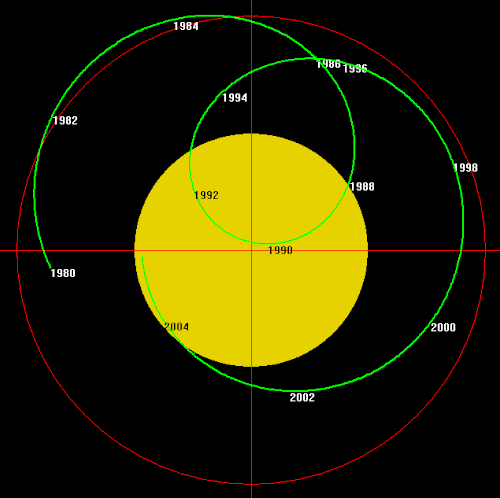
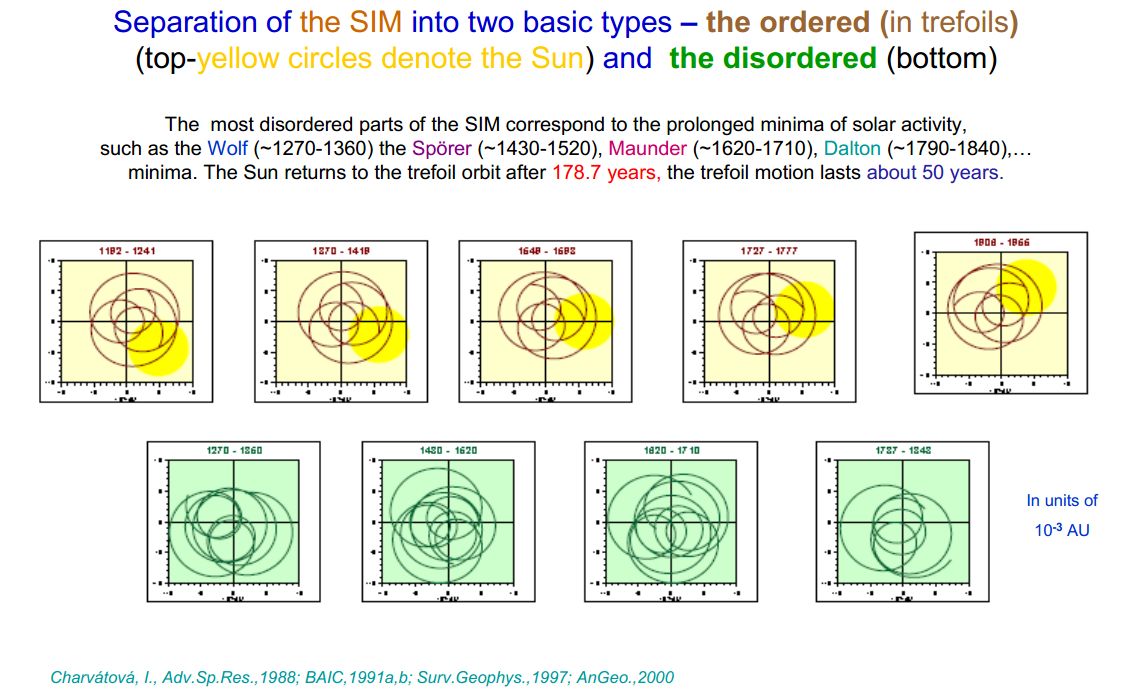
AMT begins with the orbital path of the Sun. The Sun does not remain stationary in the centre of the solar system, but instead orbits a point or gravitational centre of the solar system (SSB). The gravity of the outer 4 planets determines the daily position of the Sun which follows a kaleidoscope pattern orbit around the SSB. The orbit shape is basically an inner loop followed by and outer loop and is primarily controlled by Jupiter and Saturn.

Fig. 2

At its greatest point the Sun can have its centre 1.6 million kilometers from the SSB and also experiences a 100% velocity change compared to the inner loop that generally returns to the SSB, the two loops each follow a rough 10 year timeline which DO NOT line up with solar cycles. Solar Angular Momentum is calculated from these movements and can be seen in Carl’s famous graph.

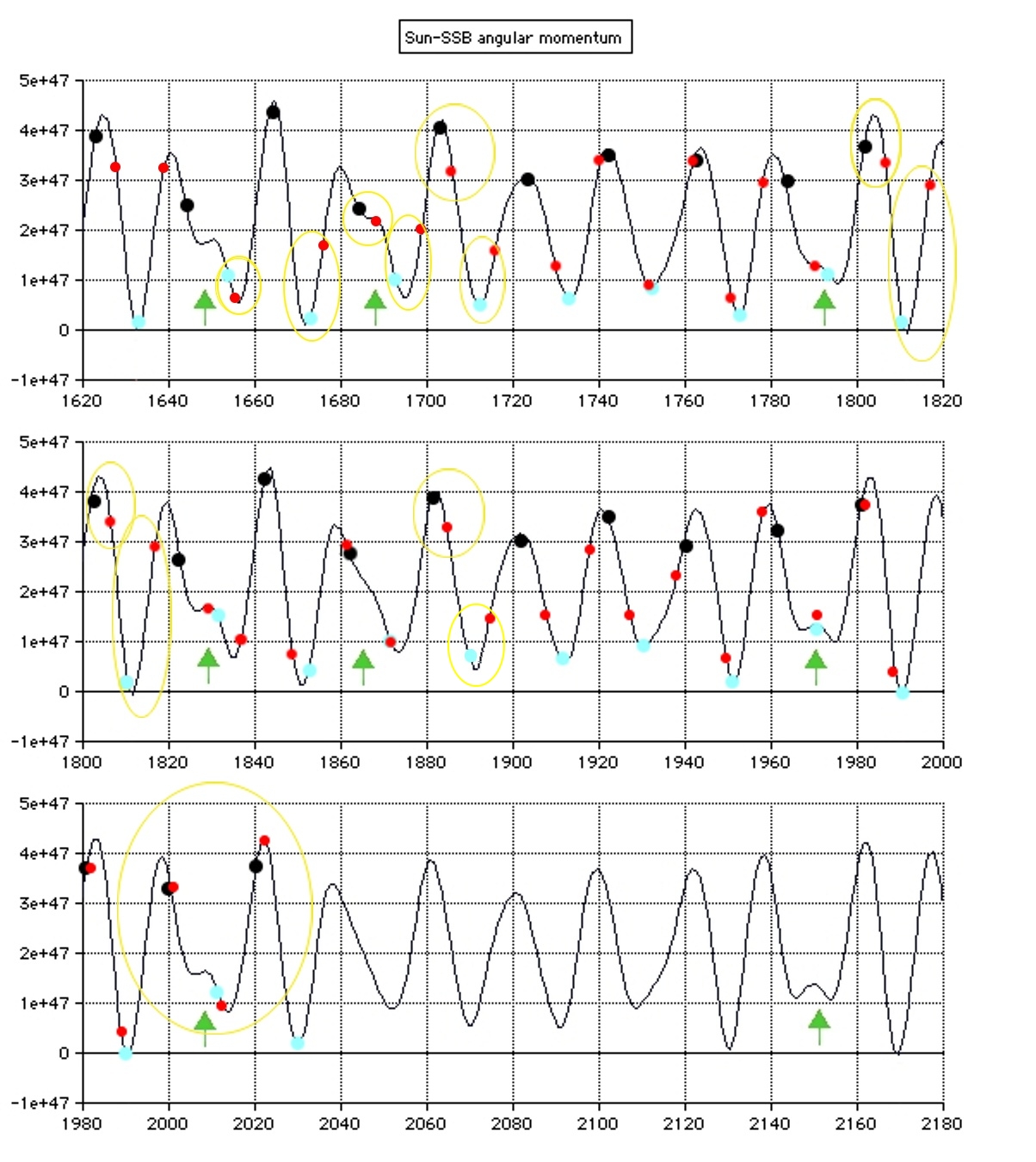
Fig. 3. Carl’s Graph derived from JPL data.

AMT has two cornerstone forces.

1. The Modulating Force.

2. The Disruptive Force

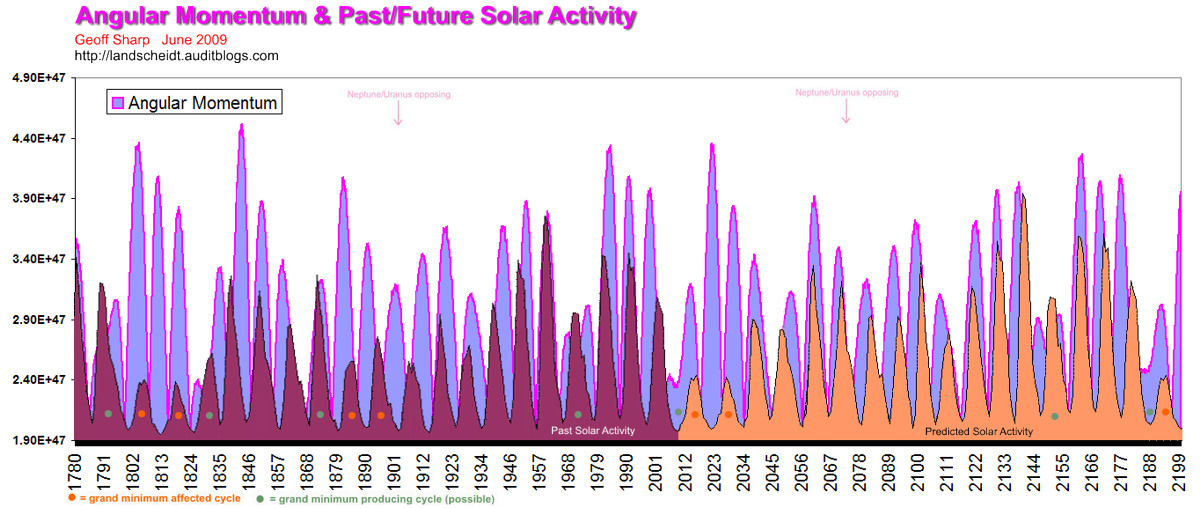
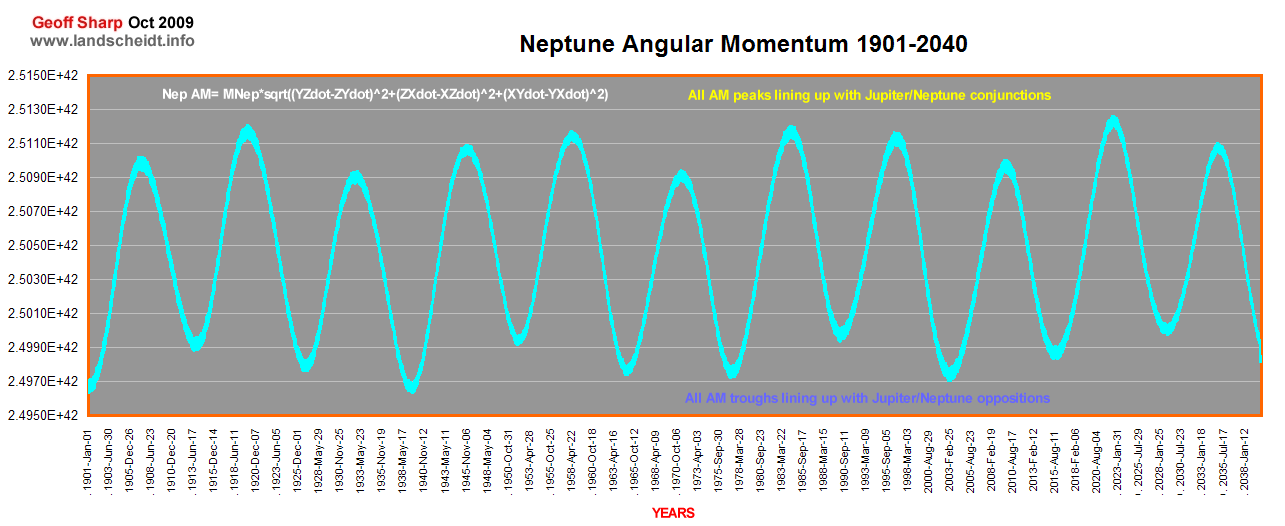
Fig.1 shows a pink powerwave that modulates the height of solar cycles and is the Modulating Force. This wave follows the general trend of solar activity which correlates with the solar Angular Momentum (AM) wave. This wave has been described many times in science and is sometimes called the Gliessberg cycle, the AM wave is powered by Jupiter and Saturn but is modulated by Uranus and Neptune as they return to conjunction every 172 years (this function also recently observed by Scafetta). While observing the modulating wave it is important to understand the integration of the Disruptive Force which can easily knock out the high solar cycles at the peak of the wave.

The Disruptive Force is the only variable in solar output (other than the smaller Modulating Force) and ultimately is what controls the shape of the Holocene solar record. The Disruptive Force comes from two particular planetary positions that occurs in groups near the top of the AM modulating wave. The Main Disrupting Force is experienced when the outer 4 planets are in the position shown in Fig 4.

Fig. 4. Type “A” at 30 deg. being amongst the strongest perturbations and grand minima of the Holocene.

Uranus and Neptune when near conjunction alter the normal pattern of Angular Momentum because of their combined gravity as seen at the green arrows on Fig.3. At the same time the normal path of the Sun is altered as seen by the purple curve on Fig.2. Charvàtovà and others have noticed that solar grand minima occur during times of the altered path of the Sun but now we can understand how to quantify the solar downturn that occurs during the altered path. The altered path of solar cycle 20 is not that different to the current cycle but the results should be very different. There is also another altered path (Type “B”) that is generally weaker but just as important and not observed by Charvàtovà. The Disruptive Force or Angular Momentum Perturbations (AMP) occur in groups separated by roughly 40 years either side of the height of the Uranus/Neptune modulating wave. Most common is three groups per 172 year cycle (avg) but can be as few as two and as many as five. By understanding the strength of each disrupting or AMP event we can determine the amount of solar downturn for the era, this is done by observing the perturbation shape on Fig. 3 at the green arrows and by also observing the 4 outer planet angles in relation to each other as seen in Fig.4. and Fig. 5.

Some may ask why does the Disruptive Force have so many different strengths and occurrences during the height of each 172 year wave. Jose back in 1965 made the mistake of declaring the outer 4 planets return to the same position every 178.8 years. This simply does not happen and can easily be verified by using any online solar system viewer and going back in steps of 179 years. The orbital mechanics of the outer 4 planets move very slowly over thousands of years whereby the positions evolve and never return to the same position (but come close every 4630 years or 27 x 172 yr cycles). This evolution of the outer 4 planet positions is what shapes the Holocene solar record seen in Fig 5.

Fig. 5

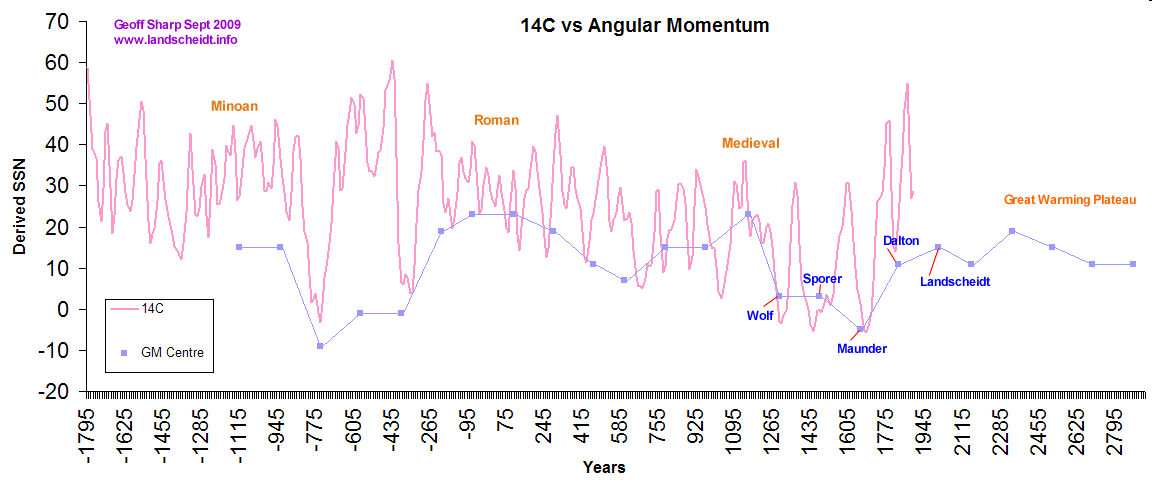
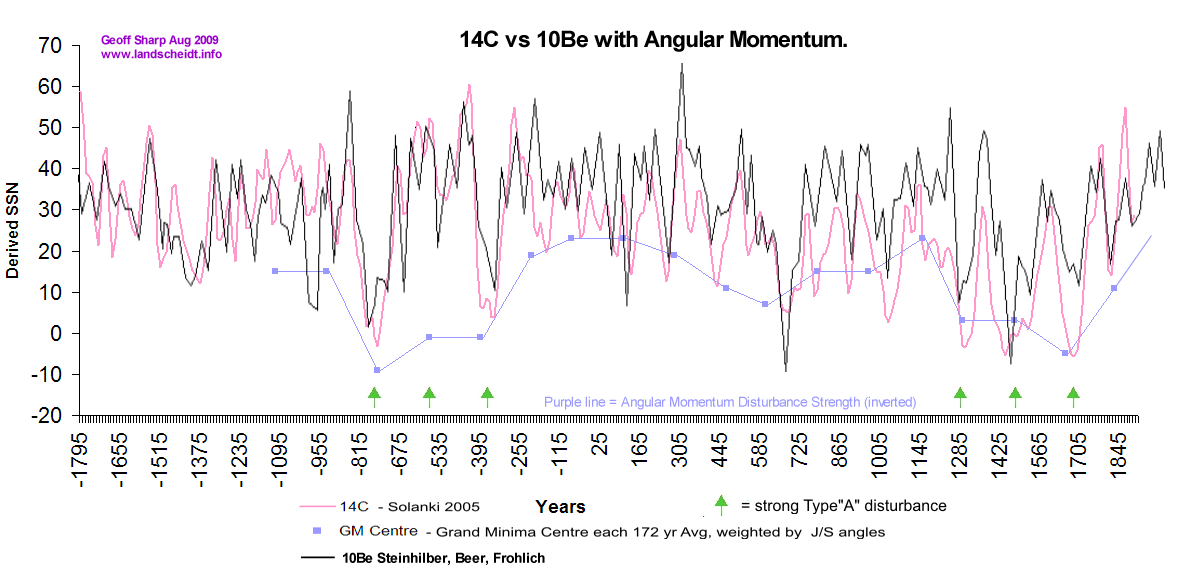
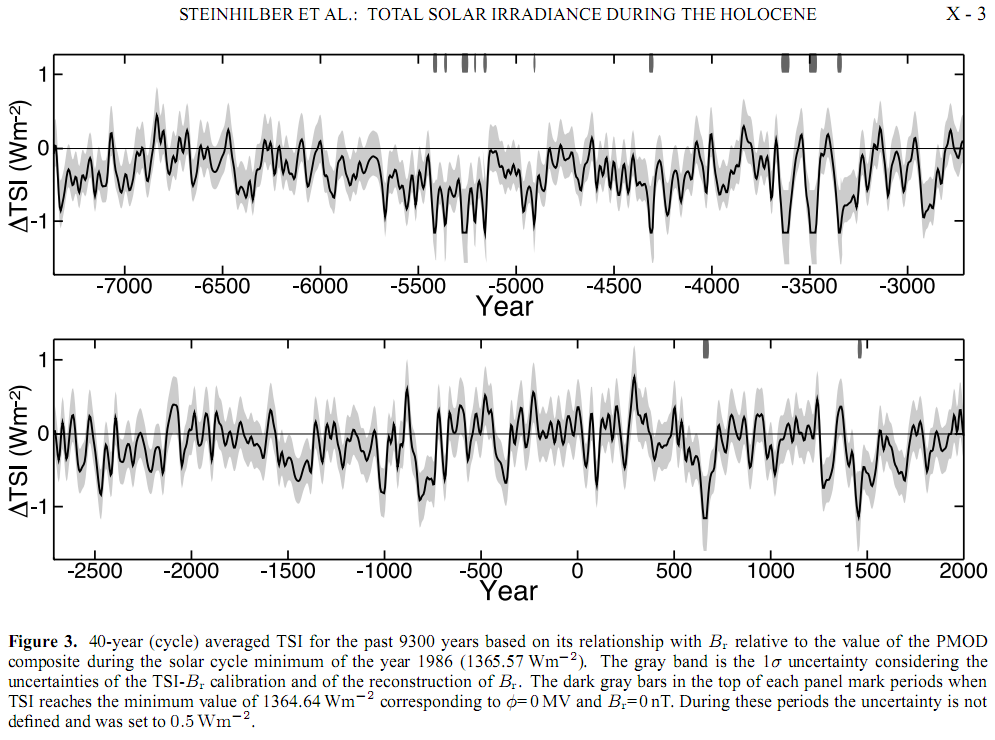
When looking at solar output over greater timeframes another powerwave is observed. This wave is the Holocene record itself which is determined by the strength of the Disruptive Force over the 11,500 year record. Strong alignments of the outer 4 planets coincide with deep grand minima, while weaker alignments agree with the Medieval,  Roman and Minoan Warm Periods. This is also observed in Fig. 6 when comparing the quantified AMP events with the Holocene isotope record.

Fig. 6 Figures 5 & 6 plotted from original Solanki (INTCAL98) carbon 14 data

AMT does not include what determines the length of the solar cycle and there are times when the Disruptive Force is weakened because of timing. If the AMP event happens near cycle max the full effect is not realized. It is thought that the Disruptive Force causes a “phase catastrophe” in the Hale cycle whereby one solar pole does not reverse polarity which then takes another full cycle before recovering. If the timing is wrong this will not occur, 1830 is a good example in the modern record.

Understanding the mechanics of both forces makes it relatively easy to understand the rest of Angular Momentum Theory and the power of the Angular Momentum wave, it should also be obvious that because of the inconsistancies in the wave, a firm recurring pattern of grand minima is not possible. There is now a peer reviewed paper by Wolff and Patrone that provides a mechanism for planetary control of solar output. If there are any questions on quantifying the Disruptive Force or any other area I am most happy to respond in comments.

A full version containing more information is available in my paper HERE.

Geoff Sharp.

April 29, 2011

Solar Cycle Induced by Rotating Medium.

Filed under: Uncategorized — Geoff Sharp @ 1:36 am

Bart Leplae has a new paper published in the General Science Journal that proposes a new method of spin orbit coupling that could be responsible for rotation changes at the Sun. Bart outlines a few principles in his introduction.

Introduction
• Scientific Publication: “Does a Spin–Orbit Coupling Between
the Sun and the Jovian Planets Govern the Solar Cycle?”
(I. R. G. Wilson, B. D. Carter, and I. A. Waite, 2007):
– Presents evidence to show that changes in the Sun’s equatorial
rotation rate are synchronized with changes in its orbital motion
about the barycentre of the Solar System
– Proposes that this synchronization is indicative of a spin–orbit
coupling mechanism operating between the Jovian planets and
the Sun
– While data are consistent with the idea that there is a spin–orbit
coupling between Jupiter and the Sun, it does not tell anything
about the true nature of the underlying mechanism that might
be causing this coupling
• This paper proposes the Rotating Medium Model as the
underlying mechanism for the Spin-Orbit Coupling.

A link for the paper can be found at   http://www.wbabin.net/files/4354_leplae4.pdf

The paper does not explain how planetary alignment might affect solar rotation rates during solar grand minima but other points might be of interest to readers. Comments and discussion is encouraged.

December 24, 2010

Is the World Ready for another Ice age?

Filed under: Uncategorized — Geoff Sharp @ 4:57 am

Little Ice Age conditions are sweeping across most of the northern hemisphere creating travel chaos, financial damage and, unfortunately, many deaths in the process. I predicted this back in July 2010 in my ” A Massive Winter Heading for the Northern Hemisphere?” article that has come home to roost. An excerpt I predict the extra boost from my predicted solar grand minimum along with the current oceanic conditions the next northern winter will experience conditions similar to the Little Ice Age (1250-1850).”

The conditions are perfect at present for continued cold, the oceans are cold with the important atmospheric oscillations forcing cold arctic air further south than usual. The negative AO and NAO are producing blocking high pressure cells that bend the jet stream which allows the southern movement of arctic air. At present there is an unusual permanent high pressure cell over Greenland.  I think this pattern should prevail over the next 20 to 30 years and replaces the positive pattern of the last 30 years. The global warming models have suggested that man-made CO2 will keep the AO and NAO in positive mode….how wrong have they been?

Many are asking what causes the global ocean and atmospheric oscillations to follow these heating and cooling trends. The Pacific Decadal Oscillation (PDO) is a large player that has a 60 year cycle, this follows the solar velocity oscillations as the sun orbits the centre of the solar system as described by Scafetta. The NAO works very closely with the PDO but is possibly governed by changes in the height of the atmosphere as a result of the reduced EUV that is a product of a quiet Sun. NASA has reported that the height of the Thermosphere is at the lowest point since records began; EUV is a controller of atmospheric height. We are told that the TSI or total heat output of the Sun only varies by 0.1 percent over a typical solar cycle. But we are now learning that the Sun has other ways of affecting climate that the models have not allowed for. EUV is capable of a 16% modulation over the cycle and, at present, is refusing to ramp up. This current minimum sees the EUV level 15% lower than the previous minimum which, if correct, dispels the theory of a solar base floor.

With solar output being so crucial to climate, where are we heading in the next hundred years?

Right now I think we are heading into a solar grand minimum that will last 2 cycles producing a very different world compared to what we have experienced over the last 30 years. After that a brief warming will occur before slipping into a familiar pattern that started in the early 1900′s, which is more cooling gradually warming over several decades. The Sun is controlled by its angular momentum which is in turn controlled by the outer planets…My published paper has all the details for those wishing to dig deeper.


Click on the pic for a larger view.

But is there more? There are two types of global cooling – one is solar output modulation as discussed, but lets look at the other. Over the past several million years the planet has spent around 80% of its time under ice. There is a regular pattern as discovered in the Vostok ice cores that show us a roughly 100,000 year cycle of ice ages. Mankind for the past 11,000 years has enjoyed the Holocene which is an interglacial or warm period that will soon come to an end. The outer planets over long periods influence the shape of the earth’s orbit via gravitation perturbations. This has the effect of changing the way heat is received from the Sun which leads to a gradual build up of snow/ice that does not melt during summer in the northern hemisphere. But looking at the ice core records we can see a fairly abrupt change in temperature that suggests there is another factor in play governing what tips us into the ice age plunge. It is very possible that a solar grand minimum that is in position at the right time could assist the natural orbital changes as outlined via the Milankovitch Cycles. A kick start forced on by 30 years of negative PDO, AO and NAO might be all that is needed to push us over the edge…we are well overdue, but of course this is highly speculative.


We are now two years into solar cycle 24 and today we are heading into our 8th consecutive spotless day as counted by the Layman’s Count.  This cycle is currently undercutting the first cycle of the Dalton Minimum. Solar F10.7 flux has struggled to get over 80 all year and currently this month is likely to show a further decline. If you would like to follow the daily progress of solar cycle 24 be sure to check out the Layman’s page and I also encourage any questions and discussions relating to this article, simply register as a user and fire away.

October 14, 2010

New Evidence of Barycentric Motion of Exoplanet Host Stars.

Filed under: Uncategorized — Geoff Sharp @ 4:02 am

A new paper by Perryman M.A.C. & Schulze-Hartung T. has been published on the 5th October 2010 that records the barycentric motion of distant stars that have exoplanets.

A link to the full paper found HERE.

Barcentric movement is a principle component of discovering exoplanets belonging to distant stars which display a wobble over time. This demonstrates the star is being affected by the standard laws of physics associated with large orbiting bodies. Stars with large enough planets move around in their planet generated gravity well just like we see in our own star. But looking at the patterns from some distant stars that have now been made available we can see our star is perhaps unique in one respect. Our own star follows a fairly regular ordered pattern as we see in the other stars shown (other stars shown in the paper), but that ordered pattern is disrupted about 3 times every 172 years on average when Uranus & Neptune come together and add their gravity together. This throws the system out of balance for awhile until they move apart and let Jupiter and Saturn get back to their normal balanced rhythm.

Neptune & Uranus also contribute to a modulation in the available angular momentum (AM) associated with the Sun, without their influence AM would be consistent across the centuries which according to theory would result in solar cycles of equal strength. Barycentric patterns need to be observed over long frames but as they are shown in this paper it would suggest these distant stars would probably not see a regular pattern of grand minimia type disturbance as we experience along with very even cycle strength.

I contacted Michael Perryman and being in the Astronomy world was not aware of the work done at Landscheidt.info. He was interested and also provided some links to papers that show exoplanet host stars that display star spot activity. Michael is not an expert in the star spot field but perhaps one day it will be shown that only exoplanet host stars are capable of star spots or at least capable of star spot cycles.

Links Below.

Transiting systems with probable star spots:

- HD 189733 http://esoads.eso.org/abs/2007A%26A…476.1347P
- HD 209458 http://esoads.eso.org/abs/2008ApJ…683L.179S
- TrES-1 http://esoads.eso.org/abs/2009ApJ…701..756D
- OGLE-TR-10  http://esoads.eso.org/abs/2009A%26A…505..901B

June 7, 2010

Scafetta’s New Paper

Filed under: Uncategorized — Geoff Sharp @ 3:58 am

Empirical evidence for a celestial origin of the climate oscillations
and its implications
.

scafetta

Nicola Scafetta has just published a new paper which I think will become one of the cornerstone publications on our future understanding of the Earths climate system.

The PDF file is freely available from http://arxiv.org/abs/1005.4639

Nicola’s new paper adds more detail and consolidates his EPA speech given Feb 26th 2009. The main thrust of his paper is the overwhelming references that point to a quasi-60 year cycle in the Earth’s climate system that correlates and lines up with the observed solar movements about the SSB (solar system barycentre). The same principles of the 4 outer gas giants as seen in my recently published paper are employed and there is a lot of symmetry between both areas of research. Nicola is prescribing an astronomical driver to our climate cycles and I am nominating the same solar system dynamics as a driver of solar output. The two can be mutually exclusive but look to mainly work in unison.

scafetta

One of the main climate drivers is the PDO (Pacific decadeal oscillation) which aligns with solar velocity modulation, the other metric that Nicola shows is the solar distance from the SSB which moves in 20 year approx modulations but fluctuates higher when Uranus & Neptune are in conjunction (see top graph). The two oscillations combining to achieve the largest amplitude of modulation for over a hundred years that also corresponds to the large temperature increase between 1970 and 2000. The IPCC determines this as an AGW forcing but perhaps they have been riding a wave driven by celestial forces that is now crashing down around them? The celestial patterns have been coming off a high at around 2000 and are now well and truly on the decline phase, with the PDO also into its cool phase. Add to this the Landscheidt minimum and the stage is set for a reasonable period of cooling along with a platform to prove/disprove our theories.

Below is some excerpts from Nicola’s paper showing some similarities in our research.

The sunspot cycle also presents a bi-modality with periods that
oscillate between 10 and 12 years, that is between the opposition-
synodic period of Jupiter and Saturn and the period of Jupiter,
respectively (Wilson, 1987). Two large temperature cycles (#5
and #6) are present within this spectral range. Ogurtsov et al.
(2002) found evidences for a 60–64 year period in 10Be,14C and
Wolf number over the past 1000 years. Ogurtsov et al. found
45-year cycles, 85-year cycles plus bi-secular cycles in the solar
records. These findings indicate that Jupiter, Saturn, Uranus and
Neptune modulate solar dynamics.


Then, a varying Sun modulates climate, which amplifies the effects of
the solar input through several feedback mechanisms. This
phenomenon is mostly regulated by Jupiter and Saturn, plus
some important contribution from Neptune and Uranus, which
modulate a bi-secular cycle with their 172 year synodic period.

Fig. 5. (A) Distance and (B) speed of the Sun relative to the CMSS. Note the 20 and 60 year oscillations (smooth dash curves), which are due to the orbits of Jupiter and Saturn. In addition, a longer cycle of about 170–180 years is clearly visible in (A). This is due to the additional influence of Uranus and Neptune.

March 30, 2010

Website Paper Published.

Filed under: New Research,Papers & Data — Geoff Sharp @ 6:09 am

After much encouragement from Nicola Scafetta and others I have finally produced a document that summarizes the articles on this site in a scientific format. The document is 15 pages in PDF format and hopefully will enable easier understanding of the entire theory presented on this site.

The paper was published May 31 2010 in Physics/Geophysics, Cornell University Library.

Thanks to G. E. Pease for providing peer review and content.

Also many thanks to Nicola Scafetta for providing advice and initial peer review.

Download PDF file (2.4mb)

http://arxiv.org/ftp/arxiv/papers/1005/1005.5303.pdf

November 23, 2009

We Have Moved Address….

Filed under: Uncategorized — Geoff Sharp @ 12:49 pm

The original blog pioneered by Carl has moved….Auditblogs is no longer in existence brought about by hardware failure. We thank John A for providing a great platform that continues to advance solar science.

The original  addresses will still re direct to the new site, so nothing is lost :)

UPDATE  30th Nov: The original landscheidt.auditblogs.com address is also now operational, both sites coming under the one administration.

November 4, 2009

Spin Orbit Coupling – The Missing Angular Momentum Found?

Filed under: New Research — Geoff Sharp @ 6:57 pm

Spin Orbit coupling is the transfer of orbital angular momentum to spin momentum between orbiting bodies. Total angular momentum (AM) is made up of orbital & spin momentum and both must balance. If there is an imbalance between solar AM and Planet AM we might have the missing AM to fuel a rotation change at the Sun. In a recent paper by Ian Wilson et al  “Does Spin Orbit Coupling Between the Sun and Jovian Planets Govern the Solar Cycle?” Ian discusses a viable theory of spin orbit coupling but also states there is no mechanical link. Perhaps now there is a new line of inquiry that may provide this mechanical link.

AM must always be conserved and this basic principle of the universe is seen all around us, one example is the Earth/Moon system where the reducing rotation speed of the Earth caused by tidal friction sees a conservation where the Earth/Moon distance increases by about 5cm a year.

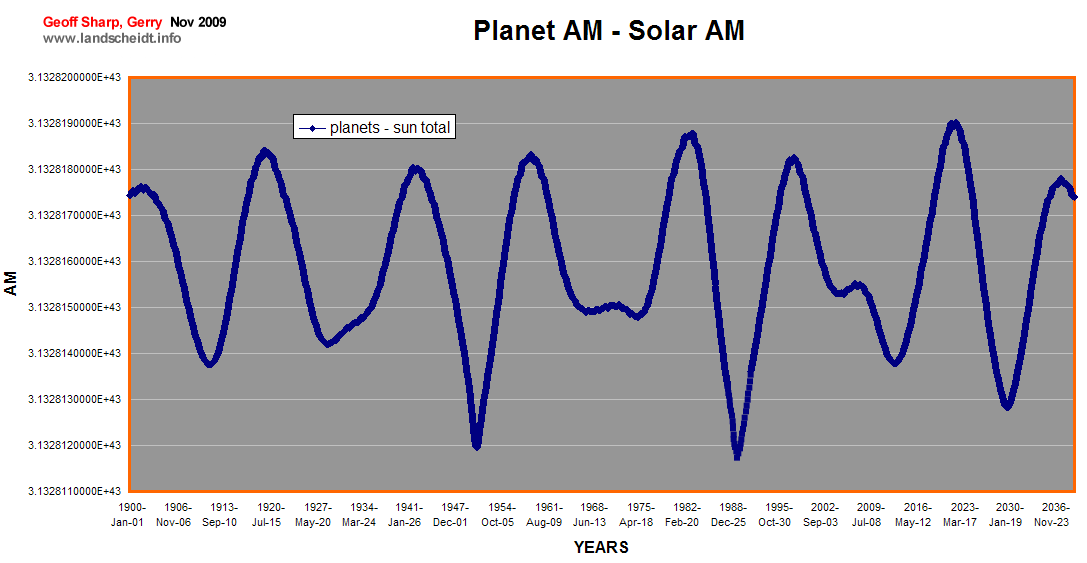
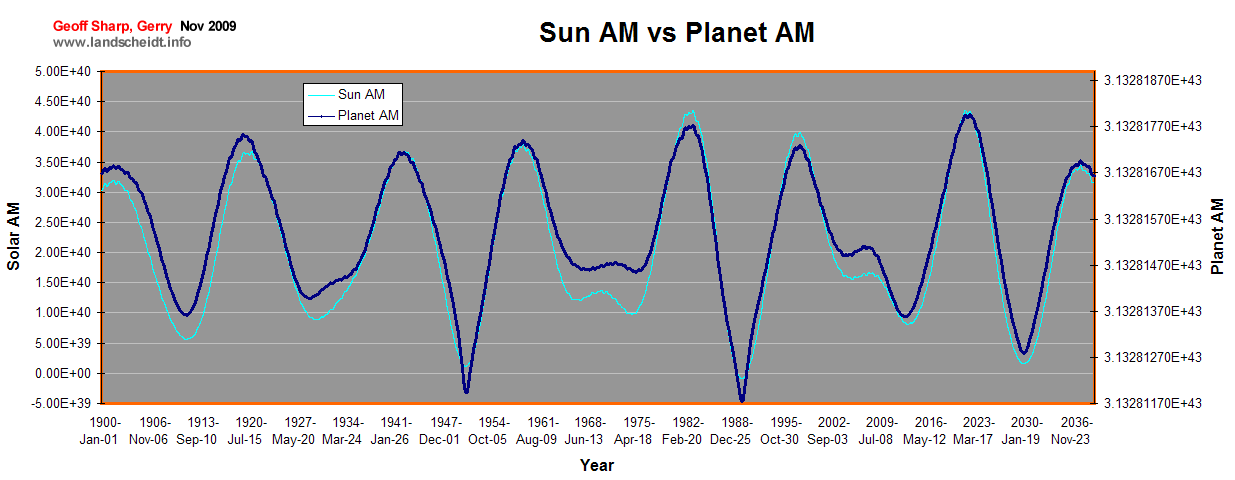
Spin orbit coupling could be one area that may provide a link between the Planetary motions and a changing rotation speed of the Sun, basically if there is a mismatch in orbital AM it can be transferred to spin momentum (rotation speed). The Sun has it own angular momentum as it orbits around the centre of the solar system. 99% of this comes from the gravitational affects from the combined positions of the Jovian planets, this is clearly seen in Carl’s famous graph. Each planet also has its own AM which is  mass x distance x velocity, and as I have shown previously AM can be calculated using the SSB (solar system barycenter) or the Sun as the orbit axis point. If we measure the planet AM it can be compared against the solar AM and if done correctly any variation or missing AM can be determined. In the past this has been done by wiggle matching which is comparing 2 graphs, rescaling one to fit the other and comparing. This method does not provide mathematical results and the detail can be hidden in the scale of the graph.

I have always wanted to do my own comparison and in particular use the Sun as the orbit axis point when calculating planet AM. Gerry and I have collaborated on this project and combined our skill sets to produce an outcome.

To compare planet AM with Solar AM the inertial frame should be the same. The planet inertial frame calculated from JPL was another surprising result which looks to suggest it is in the barycentric frame rather that heliocentric. For our project we needed to make allowances. The project calculates planet AM using the Sun as the orbit axis point and the solar AM is calculated using the SSB as the axis point, then the solar AM is subtracted from the planet AM and the results recorded, Gerry explains ” By subtracting the solar orbital AM, we are making a simple Galilean transformation from the barycentric inertial frame for the freefall motion of the Sun about the solar system barycenter to the inertial frame of the Sun itself.  The reason we have to do this is that your planet position and velocity vectors are heliocentric.  Coordinates, and properties like AM derived from them, have to be in the same inertial frame as the inertial body (or alternatively a barycenter) to which they are referred.  That’s why I was surprised to see that the heliocentric Horizons data was referred to the barycentric frame used by the JPL DE ephemerides.”

The planet AM values were carefully calculated specifying the planet barycenter coordinates where applicable, and using planet mass measurements (13 decimal places) and velocity/distance coordinates xzy from the JPL Horizons database. The asteroids Ceres, Juno, Vesta and Pallas have been included. The initial planet AM values when summed showed a moving variation (not a constant as some have suggested) of each daily measure and when wiggle matched, lined up precisely with the solar AM curve, BUT there is detail missing that must be uncovered.

The next step was to subtract the solar AM from the planet AM to achieve the same inertial frame. The finished data showed a remarkable result that is still a work in progress value but at this stage looks promising. We have calculated an underlying fluctuating AM value that nearly follows the same curve as previously calculated by Carl. It makes up roughly .0000035% of Jupiter’s AM and could represent .2% of the average solar AM. These calculations are still in progress.


Here we have a comparison of Solar AM and the Planet AM variance…there is no way we can wiggle match these two data sets, the divergence points are of particular interest. The spreadsheet will be available in full detail shortly.

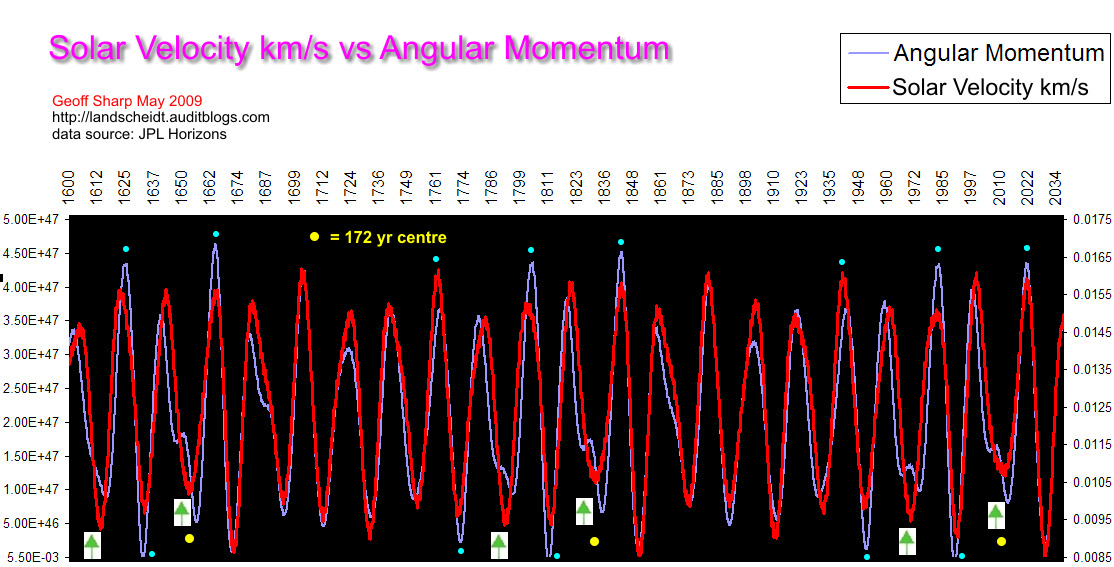
UPDATE: Some food for thought, below is the solar AM vs solar velocity graph (another wiggle match attempt). I have mentioned before that the two curves go out of sync which is strange for 2 data sets that are reliant on one another. It may be just a result of the mix between distance and velocity. The bigger variances look to line up with the bigger variances on the Sun vs missing AM graph.

If there proves to be an imbalance between solar and planet AM it could be traded off in velocity or spin or distance. Distance is unlikely and as seen the velocity does not follow a consistent pattern (although it is still a pattern). The first disturbance of the set (green arrows) sees a decrease in velocity, the second disturbance shows an increase…its not uniform. The blue dots also showing a divergence in the same places as the previous graph.


Next Page »

Theme: Rubric. Blog at WordPress.com.

Follow

Get every new post delivered to your Inbox.